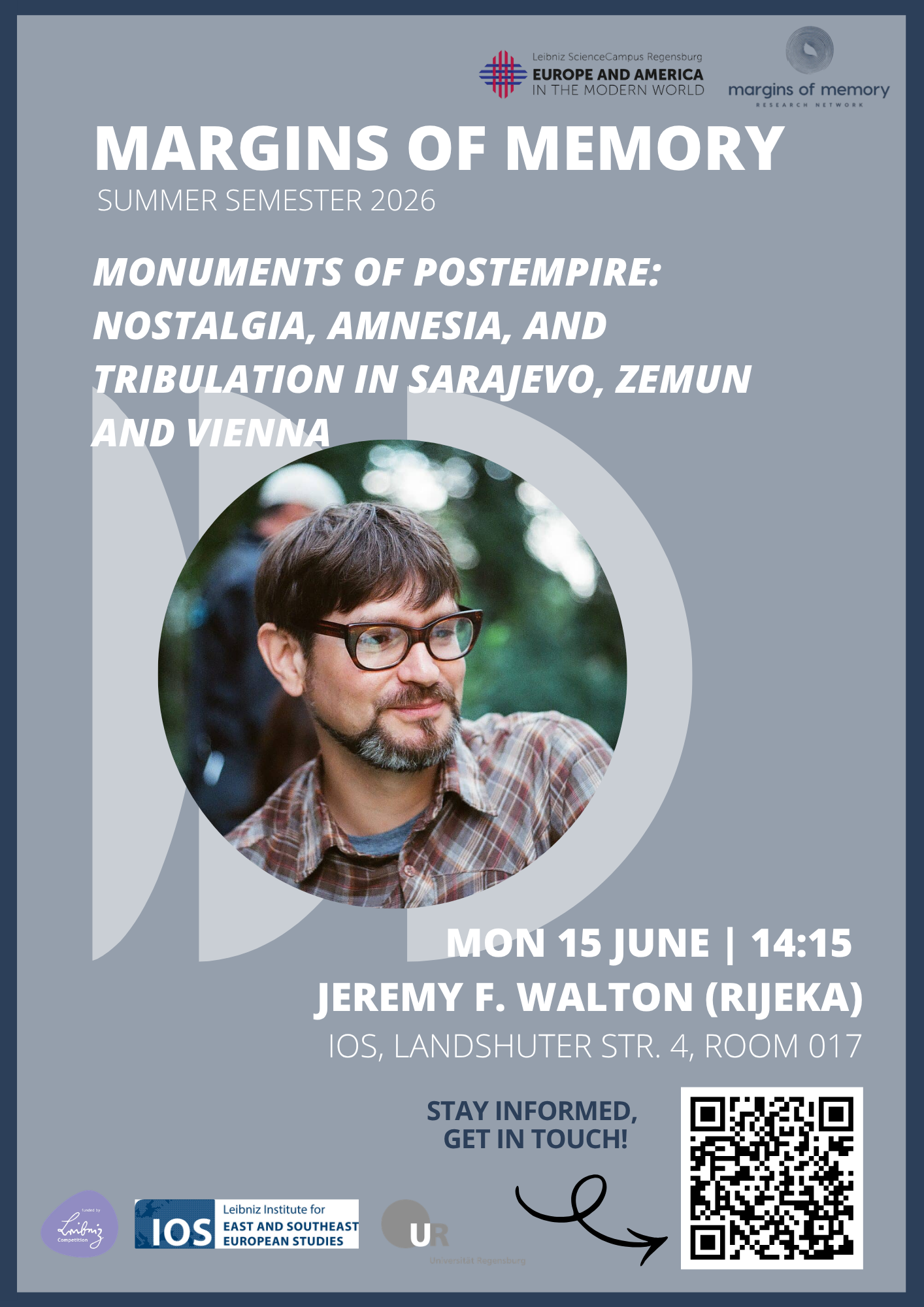
Margins of Memory Talk | Jeremy F. Walton (Rijeka) Monuments of Postempire: Nostalgia, Amnesia, and Tribulation in Sarajevo, Zemun and Vienna
When? Monday, 15 June, 14:15-15:45
Where? Room 017, AlFi/IOS, Landshuter Str. 4
Abstract | In this lecture, I introduce the broad notion of “postempire” in order to explore the textures and contradictions of three Habsburg-era monuments: Sarajevo’s Sebilj fountain, Zemun’s Gardoš Tower, and Vienna’s Pummerin Bell. To begin, I outline a constellation of concepts that bolsters my theory of postempire, including postimperial uncanniness, inter-imperial sites of memory, and the discursive trio of nostalgia, amnesia and tribulation. Following this, I turn to three monumental sites in three formerly Habsburg city. First, I argue that Sarajevo’s Sebilj—an Orientalizing fountain designed by an Austrian architect—encapsulates the irony of imperial nostalgia. Sebilj’s aesthetic connotations seem to gesture to the city’s Ottoman past, and therefore belie the fountain’s Habsburg provenance. Next, in Zemun—a former Habsburg border town that is now incorporated within Belgrade—I examine the Gardoš Tower as an exemplary site of postimperial amnesia. Despite the monument’s prominence as a sentinel overlooking the Danube, the imperial political vision that it embodied, the 1896 millennium of the Hungarian Kingdom in the Carpathian Basin, is largely a matter of indifference and ignorance in Serbia today. Finally, I trace the tribulations of Pummerin, a giant bell housed in the north tower of Vienna’s Stephansdom Cathedral. Pummerin’s central location in both Vienna and Austria at large represents a domestication of inter-imperial violence, as the original bell was forged from Ottoman cannonballs abandoned after the Second Siege of Vienna in 1683. To conclude, I consider the uncanny formations of inter-imperiality that each of these monuments materializes as instances of postimperial “tribulation” that preclude the dichotomy of nostalgia and amnesia.
Bio |Jeremy F. Walton is a cultural anthropologist whose research resides at the intersection of memory studies, urban studies, the comparative study of empires and imperialism, and critical perspectives on materiality. He leads the research group “REVENANT—Revivals of Empire: Nostalgia, Amnesia, Tribulation” at the University of Rijeka, Croatia, with support from a European Research Council consolidator grant (#10100290). Prior to this, he led the Max Planck Research Group, “Empires of Memory: The Cultural Politics of Historicity in Former Habsburg and Ottoman Cities,” at the Max Planck Institute for the Study of Religious and Ethnic Diversity in Göttingen, Germany. Dr. Walton received his Ph.D. in Anthropology from the University of Chicago in 2009. His first book, Muslim Civil Society and the Politics of Religious Freedom in Turkey (Oxford University Press, 2017), is an ethnography of Muslim NGOs, state institutions, and secularism in contemporary Turkey. He has also held research and teaching fellowships at the Center for Advanced Studies of Southeastern Europe at the University of Rijeka, the CETREN Transregional Research Network at Georg August University of Göttingen, Georgetown University’s Center for Contemporary Arab Studies, and New York University’s Religious Studies Program. His writing has appeared in a plethora of scholarly and popular journals, including American Ethnologist, Sociology of Islam, Die Welt Des Islams, History and Anthropology, The Journal of the Ottoman and Turkish Studies Association, Jadaliyya, and Sidecar (The New Left Review). REVENANT, which Dr. Walton designed, is an interdisciplinary, multi-sited project on postimperial memories and legacies in post-Habsburg, post-Ottoman realms, and post-Romanov realms.