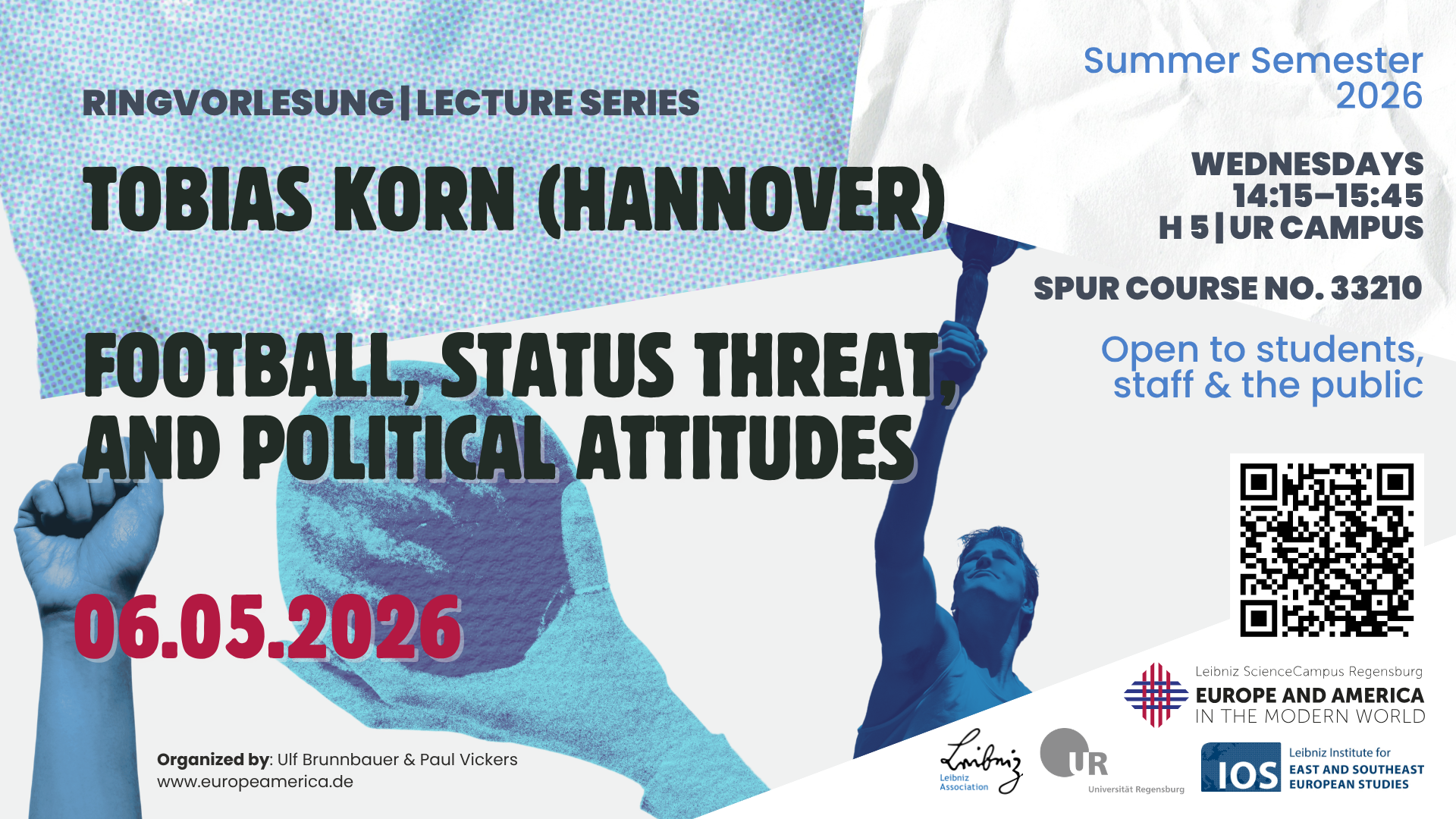
LSC Lecture Series | Tobias Korn (Hannover) Football, Status Threat, and Political Attitudes
When? Wednesday, 6 May, 14:15-15:45
Where? H5, UR Campus
This talk is part of the LSC Lecture Series on Sport, Politics, Conflict, which is organized by the Leibniz ScienceCampus Europe and America in the Modern World. The talks are open to all staff at UR and IOS, as well as the general public. UR students can sign up for the course and receive credits.
Lecture hall H5 is in the lower Central Lecture Theatre Building (Zentrales Hörsaalgebäude - ZH) located near the Audimax. UR Campus-Plan
Abstract | Why do some regions show more frustration with politics than others? We usually hear that individual worries over money and jobs are important reasons, but emotions and identity also play a big role. In this project, we look at how pride in a region can affect how people feel about their place in society and how they vote. In many places, local football clubs are an important part of regional identity. When a local team gets relegated—that is, moved from a higher league to a lower one—it can feel like a blow to the region’s pride. We study how this kind of event affects people in Germany. Using surveys and election results, we find that after a local team is relegated, people in the area feel worse about their social status and are more likely to vote for anti-establishment parties like the Alternative for Germany. This shows that events seemingly unrelated to politics can shape how people see themselves and how they engage with democracy. Emotional and cultural factors, not just economic ones, help explain political frustration in certain areas.
Tobias Korn is a Postdoctoral Researcher at the Institute of Macroeconomics at Leibniz University Hannover and is affiliated with Heidelberg University. He gained his PhD in 2023 at Leibniz University Hannover, where he is affiliated with the Research Training Group Globalization and Development, funded by the German Research Foundation. His research lies at the intersection of political economy, development economics, and economic history, with a focus on how social identity and historical shocks shape economic and political behavior. His ongoing projects explore the local and individual determinants of support for extremist parties, the fate of workers and firms during industrialization, and the long-term effects of war and colonization on economic growth and individual identities.